











This web page is created within BALTICS project funded from the European Union’s Horizon2020 Research and Innovation Programme under grant agreement No.692257.
Accomplishments of the Project "Modernization of the Irbene Radiotelescope Complex Phase 4"
Accomplishments of the Project
"Modernization of the Irbene Radiotelescope Complex Phase 4"
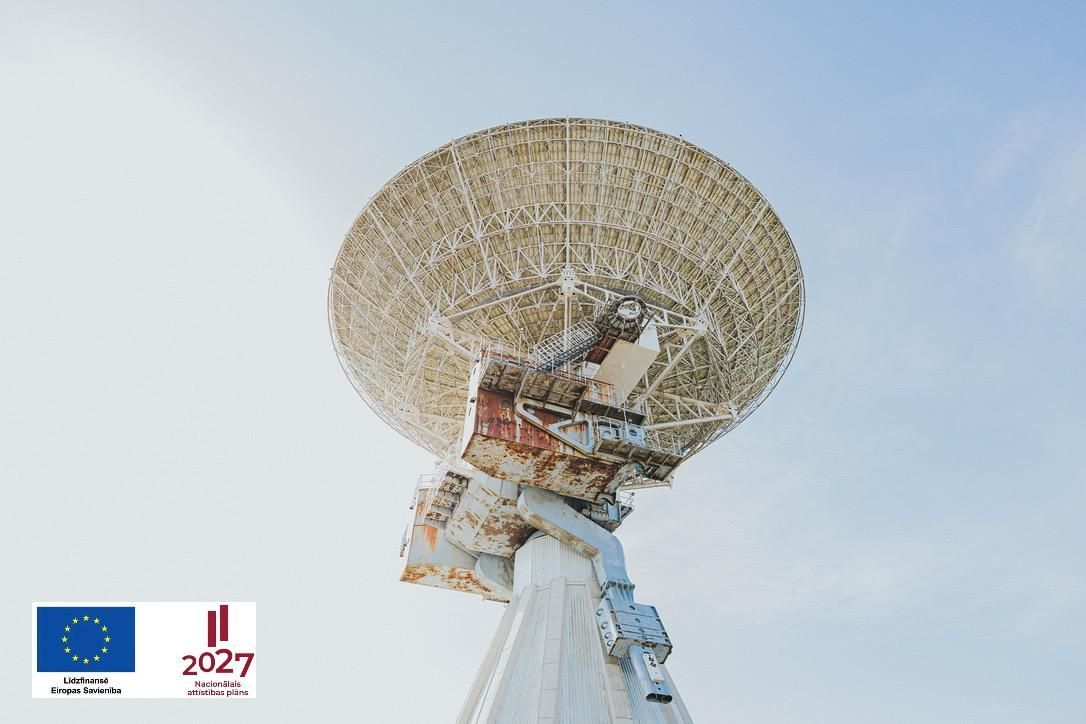
The Engineering Research Institute "Ventspils International Radio Astronomy Centre" (VIRAC) of Ventspils University of Applied Sciences (VUAS) continues to develop its research infrastructure by implementing the project "Modernization of the Irbene Radiotelescope Complex Phase 4" (Project No. 1.1.1.2/1/25/I/005), funded by the European Regional Development Fund (ERDF) with co-financing from the Latvian state budget. The goal of the project is to enhance VIRAC as a centre of excellence of national importance with modern and sustainable scientific infrastructure. Several significant procurements and activities have been carried out as part of the project.
To ensure the storage of large volumes of radio astronomy observation data, new hard drives with twice the storage capacity have been purchased for the Irbene Flexbuff data server using project funding. The Flexbuff server is used to store radio astronomy observation data, primarily from VLBI observations. The previous storage capacity had become insufficient due to the significant increase in both observation data transmission rates and the overall volume of data in recent years. The new hard drives will ensure that the storage infrastructure meets the growing data storage requirements of the European VLBI Network (EVN) and the CERN Tier-2 computing centre.
A contract has been concluded for the procurement of a six-wheeled ATV (quad bike) and its equipment. Such a mobile vehicle makes it possible to transport and test antenna, mobile satellite communication, unmanned, and floating equipment control and immunity solutions in motion. The vehicle is capable of transporting and testing research equipment in motion across the antenna complex's territory of more than 70 hectares, including forest and marsh conditions. Providing such equipment is essential for the developed systems to reach a high Technology Readiness Level (TRL) under real-world conditions. The engineering systems developed as a result of the research and tested with this vehicle have high dual-use potential.
In May 2026, a MIG/MAG semi-automatic welding machine with the necessary peripherals and a set of materials suitable for welding aluminum and its alloys was purchased. The equipment is required for manufacturing feed systems for the RT-32 and RT-16 radio telescopes in order to expand their reception bands and promote new radio astronomical observations.
As part of the modernization project, a procurement process for the photogrammetric measurement and alignment of the RT-32 radio telescope antenna surface will soon be completed. The work is intended to improve the antenna surface accuracy, sensitivity, and performance at higher operating frequencies. Currently the RT-32 antenna achieves an efficiency of only 35–38%, with even lower efficiency at higher frequency bands, making observations at these frequencies practically impossible. Photogrammetric measurements will enable the precise determination of the required position corrections for each primary reflector panel, after which the panel mountings will be adjusted accordingly to reduce the antenna surface error. Once the antenna surface has been aligned, the radio telescope's sensitivity, measurement accuracy, and observational capabilities will be significantly improved across all operating frequency bands.
Taking into account that on December 15, 2025, a positive decision was received from the European Commission regarding amendments to the European Union Cohesion Policy Programme for 2021–2027, granting flexibility funding for its implementation, contract amendments for the project "Modernization of the Irbene Radiotelescope Complex Phase 4" were signed in July of this year. An additional EUR 79,151 was allocated, of which 85% is ERDF funding and 15% is Latvian state budget co-financing. With the additional funding granted, further procurements are planned within the project for the development of VIRAC's research infrastructure: purchase and installation of spare asynchronous electric motors and their control systems required to ensure the sustainability of the motor drives for the RT-32 and RT-16 radio telescopes; purchase of systems necessary to ensure the sustainability of the RF chain and control systems for the RT-32 and RT-16 radio telescopes; and the purchase of a portable handheld vector network analyzer with a bandwidth of at least up to 26.5 GHz.
The EU financial support received under the project "Modernization of the Irbene Radiotelescope Complex Phase 4" (No. 1.1.1.2/1/25/I/005) strengthens VIRAC's capacity to conduct high-quality radio astronomical observations and develop new, dual-use research competencies, while ensuring the sustainability and international competitiveness of the Irbene Radiotelescope Complex.
30.07.2026.
Prepared by: Arita Rubīna
Project Public Relations Specialist